Joan leaves Harold and his father
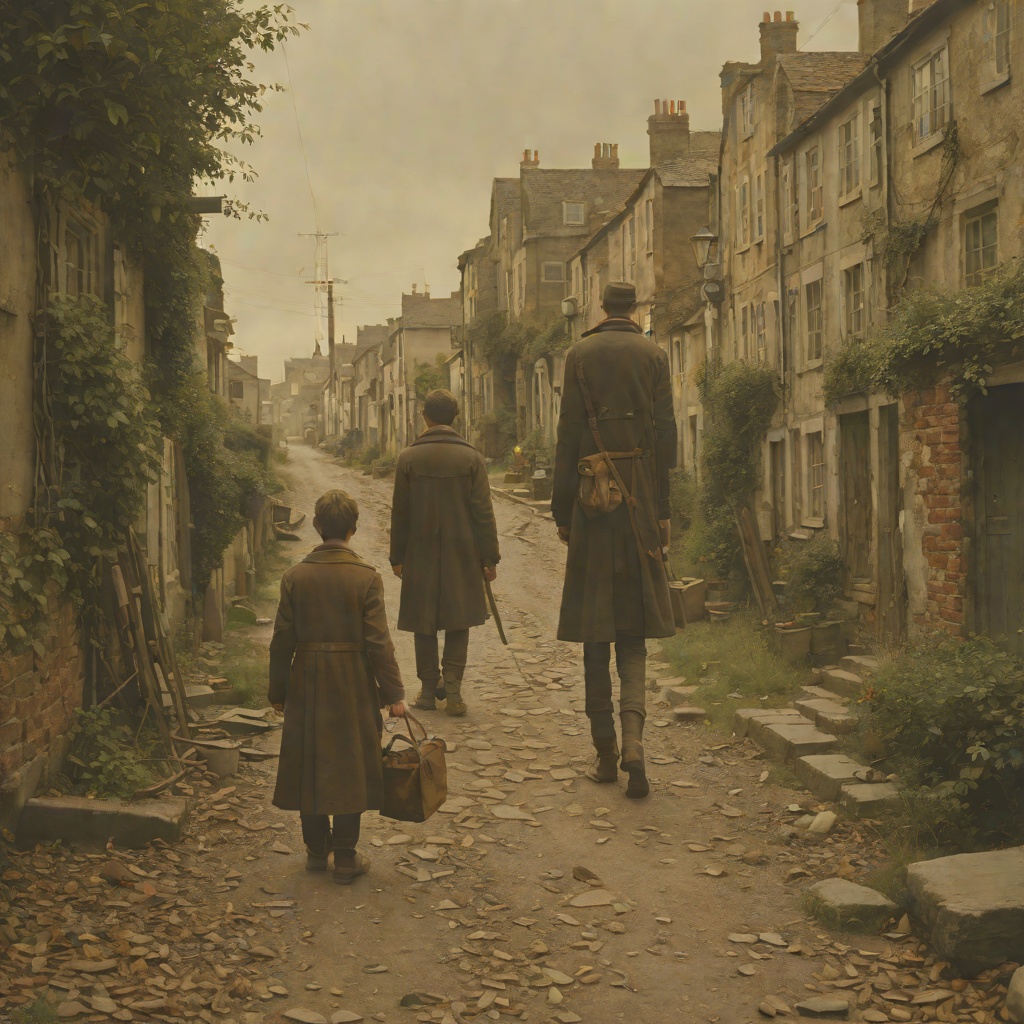
The Unlikely Pilgrimage of Harold FryJoan leaves Harold and his father is the founding wound of Harold Fry's life, the childhood abandonment whose echo he carries for decades and which his pilgrimage to Berwick-upon-Tweed forces him to confront. The event occurs when Harold is a teenager, already looming over his father but still small enough that he likes the fact he only reaches his mother's shoulders. Joan lifts her suitcase, arranges a long silk scarf round her neck so that it hangs down her back like hair, and prepares to walk out of the family home. When Harold asks where she is going, she answers "Nowhere," even as she opens the front door. He takes hold of the scarf, just the tassels where she might not notice, feeling the silk soft between his fingertips, and asks if he can come. Her reply is a dismissal: "Don't be daft. You'll be fine. You're practically a man." She takes a deep breath as if she were about to plunge into water, and steps out. The detail of her leaving stays with Harold so vividly that decades later, walking through the English countryside, he can smell her musk scent, see the white powder on her skin, and know that if she had allowed him to kiss her cheek it would have tasted of marshmallows.
The Aftermath of Abandonment
The immediate consequence of Joan's departure is a household that collapses into a strange abundance and then into decay. Neighbours console Harold's father with the words that Joan was her own person and that it is a blessing, at least he is young enough to start again. Suddenly there is an unprecedented abundance of female life in the house: windows are thrown open, cupboards emptied, bedding aired, and casseroles, pies, jellied meat, suet puddings, jams and fruitcake wrapped in brown paper appear. There had never been so much food, because mealtimes were not of particular interest to his mother. Black and white photographs disappear into handbags, red lipsticks vanish from the bathroom along with her bottles of scent. Harold sees women on street corners and crossing roads who he mistakes for his mother, only to dash out and discover a lady he doesn't know wearing one of his mother's hats or skirts. Joan always liked the bright colours. His thirteenth birthday comes and goes with no word from her, and after six months Harold cannot even smell her in the bathroom cabinet. His father begins to fill the spaces that held his wife with distant relations, introducing Harold to an Aunty Muriel and later an Aunty Vera, who takes Muriel's side of the bed when she leaves. His father, once slumped on a kitchen chair in his dressing gown waiting for his mother, now wears a suit that sticks out from his shoulders and has even shaved.
The Letter from New Zealand
The only communication Harold ever receives from his mother is a single letter, which he recalls years later while sitting at the Fisherman's Cot overlooking the river, trying to nod and smile at strangers who tell him the bridge crossing the troubled water was the inspiration for the song by Simon and Garfunkel. The letter reads: "Deer son, New Zeeland is a wonderful plase. I had to go. Muthering was not me. Send my best regads to your dad." What wounds Harold most is not the fact of her leaving but the fact that she couldn't even spell her explanation. The misspelled words become a permanent emblem of her carelessness, a proof that she did not think him worth the effort of a properly written goodbye. The memory of his mother's suitcase by the door resurfaces years later when Harold stands in the road near his own home, having just learned that Queenie Hennessy is dying, and thinks of all the things in life he has let go: the small smiles, the offers of a beer, the people he passed over and over again in the brewery car park without lifting his head, the neighbours whose forwarding addresses he never kept, and worse, the son who didn't speak to him and the wife he had betrayed.
The School Years and the Pattern of Letting Go
At school, the boys call him Harold no-mum, and he begins to take days off, then weeks, until his classmates seem such strangers he feels he is a different species. His Aunt Muriel writes notes to excuse his absences, claiming Harold has a headache or looks pasty, and sometimes fetches out the dictionary to get more creative, declaring Harold had a spot of biliousness at about 6pm on Tuesday. When he fails his exams he stops going altogether. The abandonment installs in Harold a lifelong pattern of passive acceptance, a tendency to let people and things slip away without protest. This pattern repeats itself in his adult life: he lets his son David drift into depression and addiction without ever speaking to him, he lets his wife Maureen retreat into grief and silence, and he lets Queenie take the blame for his own vandalism of the brewery and disappear from the South West without ever trying to find her. Walking through the countryside years later, Harold recognizes that his mother's departure taught him to expect loss and to endure it silently, and that this is why he failed the people he loved.
The Memory on the Walk
The memory of Joan's leaving returns to Harold with particular force during his pilgrimage, triggered by the sensory details of the landscape. Passing allotments, he sees Maureen in the front garden of Fossebridge Road, wearing an old shirt of his, her hair tied back against the wind and her face smutched with dirt, digging in French-bean plants. He sees a bird's broken egg and recalls with splintering tenderness the fragility of David's head when he was born. He hears the hollow cackle of a crow in the silence and suddenly he is lying in his bed as a teenager, hearing that same cry, and overwhelmed with loneliness. The memory of his mother's departure becomes one of the pictures that runs freely through his mind now that he is back on the open land, between places, measuring distance not in miles but with his remembering. In walking, he unleashes the past that he has spent twenty years seeking to avoid, and it chatters and plays through his head with a wild energy that is its own. The image of his father slumped on a kitchen chair, waiting for his mother, has always been there, but on the walk he feels he is seeing it for the first time, noting that his father had maybe been sick down his pyjamas and that it was best not to breathe through your nose.
The Legacy of Joan's Departure
Joan's abandonment shapes Harold's understanding of himself as someone who is both inside and outside the world, both connected and passing through. Standing on a hillside looking out over the Vale of Gloucester, he understands that this is also the truth about his walk: he is both a part of things, and not. The lesson of his mother's leaving is that people disappear, that love is not to be relied upon, and that the proper response is to keep walking. Yet the pilgrimage also becomes his attempt to break that pattern, to prove that he can hold onto someone by walking toward them. His promise to Queenie, that all she has to do is wait because he is going to save her, is a direct repudiation of his mother's "Nowhere" and her refusal to let him come. Where Joan walked away from a child who begged to follow, Harold walks toward a dying woman who has asked nothing of him. The memory of his mother's suitcase by the door, which presses down on him so heavily at the start of his journey that he feels weak, becomes the measure of everything he must overcome. His final confession letter to the garage girl, in which he tells the full story of David's suicide and his own failures, is an attempt to stop letting things go unspoken, to break the silence that began when his mother walked out the door.